
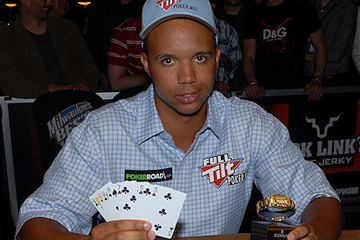
Early Life and How He Got Started
Phillip Dennis Ivey Jr. was born February 1, 1977, in Riverside, California, and grew up in Roselle, New Jersey. He learned five-card stud from his grandfather as a child, then sharpened his game for real as a teenager, using a fake ID under the name “Jerome Graham” to get into Atlantic City card rooms. He played so often that regulars nicknamed him “No Home Jerome” — a name that stuck around long after he’d outgrown it.
WSOP Bracelets and Tournament Career
Ivey won his first WSOP bracelet in 2000 in a Pot-Limit Omaha event, and by 2002 he had already tied a record by winning three bracelets in a single year. He’s added bracelets steadily since, taking his 11th in 2024 in the $10,000 2-7 Triple Draw Championship — enough to put him second on the all-time bracelet list behind only Phil Hellmuth. Notably, none of Ivey’s bracelets have come from No-Limit Hold’em; his wins span Omaha, stud, lowball, and other mixed-game formats, which is part of why he’s regarded as the most versatile top-level player of his generation.
His deepest Main Event run came in 2009, when he reached the final table and finished 7th. On the World Poker Tour, he’s won one title (the 2008 LA Poker Classic) and made multiple final table appearances. Across all formats, Ivey has more than $54 million in live tournament earnings.
Cash Games and the Andy Beal Matches
Much of Ivey’s reputation was built away from television cameras, in some of the highest-stakes cash games ever played. He was part of “The Corporation,” a group of elite pros who took turns playing Texas billionaire Andy Beal heads-up at limits as high as $50,000/$100,000. Ivey’s session against Beal in 2006 alone netted him $16.6 million — one of the most famous heads-up results in poker history, later documented in the book The Professor, the Banker, and the Suicide King.
The Edge-Sorting Scandal
Ivey’s career isn’t without controversy. In 2012, he and a partner won millions playing high-stakes baccarat at Crockfords Casino in London and the Borgata in Atlantic City using a technique called edge-sorting — exploiting tiny manufacturing imperfections on the backs of playing cards to identify high-value cards before they were dealt. Both casinos withheld or clawed back his winnings, arguing the technique amounted to cheating. UK courts sided with Crockfords, with the UK Supreme Court issuing a final ruling against Ivey in 2017. In the U.S., a federal judge ordered Ivey to repay the Borgata over $10 million; the two sides reached a settlement in 2020. Ivey has consistently maintained he broke no rules, only made smart use of information available to him.
Despite the legal fallout, Ivey was inducted into the Poker Hall of Fame in 2017 — a reflection of how the poker community separates his skill and legacy from the scandal.
Where Things Stand Today
Ivey remains active on the tournament circuit, regularly appearing in high-roller and super-high-roller events, including recent WSOP and WSOP Europe series. He no longer has any affiliation with Full Tilt Poker — the site shut down in 2011 after the U.S. Department of Justice’s “Black Friday” crackdown on online poker operators, and Ivey, once a sponsored pro and shareholder, wasn’t held responsible for the site’s collapse the way some other Full Tilt executives were. He’s since represented the World Poker Tour and continues to play at the highest stakes available, live and in select high-profile online formats.
Away from the table, Ivey remains notoriously private, rarely giving interviews and keeping most of his life out of the spotlight — a demeanor that matches the unreadable table presence he’s known for. For more on why that kind of composure matters so much at the table, see our breakdown of dominating a table, and if you want to see that composure tested in a real hand, check out our look at Ivey’s infamous WSOP misclick.
FAQ
How many WSOP bracelets does Phil Ivey have?
11, as of his 2024 win in the $10,000 2-7 Triple Draw Championship — the second-most all-time behind Phil Hellmuth’s 17.
Is Phil Ivey in the Poker Hall of Fame?
Yes. He was inducted in 2017, his first year of eligibility.
What is Phil Ivey’s net worth?
Exact figures aren’t public since much of his income comes from private high-stakes cash games, but his live tournament earnings alone exceed $54 million, and industry estimates of his overall net worth run well into nine figures.
Does Phil Ivey still play poker in 2026?
Yes, he remains active in high-roller and super-high-roller tournaments on the live circuit, including recent WSOP series.
What happened with Phil Ivey and Full Tilt Poker?
Ivey was a sponsored pro and shareholder in Full Tilt Poker from 2005 until the site was shut down by the U.S. Department of Justice in 2011. Unlike some other Full Tilt executives, he wasn’t found to have played an active management role in the site’s collapse.
